
XRP Price Stability: Binance CVD Offers Insight
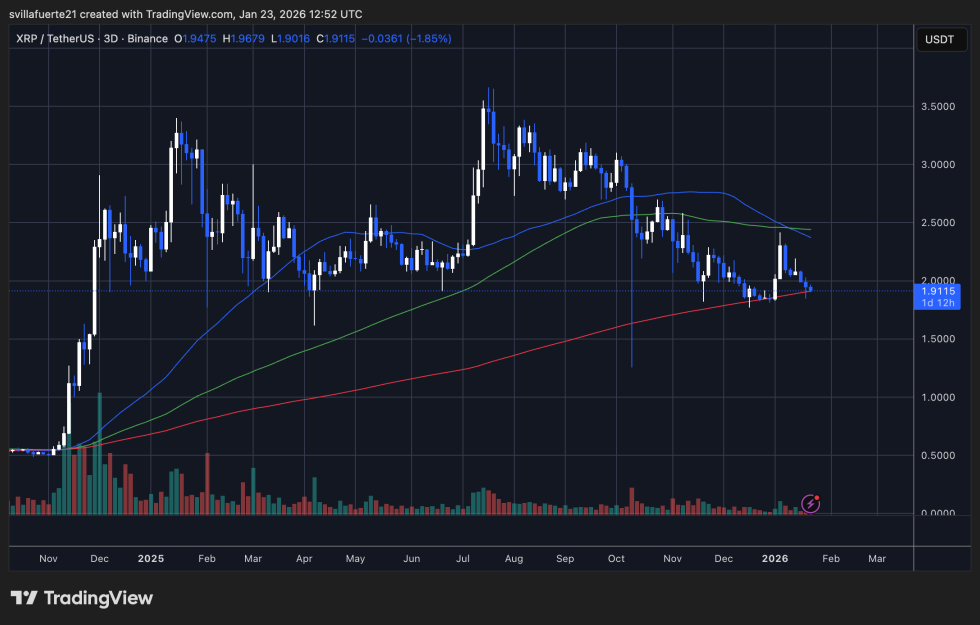
%20chart%2C%20depicting%20the%20correlation%20between%20XRP's%20price%20and%20net%20volume%20flows%2C%20highlighting%20a%20base-building%20phase.%20The%20second%20panel%20presents%20a%203-day%20candlestick%20chart%20of%20XRP%2FUSDT%20from%20TradingView%2C%20displaying%20current%20price%20action%2C%20key%20support%20levels%20around%20%241.90%2C%20various%20moving%20averages%20(short-term%2C%20intermediate%2C%20long-term)%2C%20and%20the%20overall%20downtrend%2C%20emphasizing%20critical%20demand%20zones.?width=768&height=768&seed=8158&nologo=true)
XRP is currently navigating a period of significant market uncertainty, striving to maintain stability above the $1.90 threshold after a notable dip below the $2.00 mark. This recent price depreciation has sparked considerable debate among market participants, with some anticipating a deeper bearish correction and others viewing it as a necessary deleveraging event prior to a potential rebound. As market momentum appears to wane and volatility increases, the upcoming trading sessions are poised to be critical in determining XRP's short-term trajectory.
Key Points
- XRP is attempting to stabilize above $1.90 amidst heightened market uncertainty.
- Binance data reveals a moderate to strong positive 30-day correlation (0.61) between XRP's price and its Cumulative Volume Delta (CVD), indicating coherent trend support.
- The positive price-CVD correlation suggests underlying structural alignment, hinting at a base-building phase rather than capitulation.
- Despite the positive correlation, recent CVD readings are still negative, signifying that net selling pressure currently dominates buying.
- Technical analysis shows XRP struggling below major moving averages, with the red long-term average near $1.85–$1.90 acting as critical support.
- Successful defense of the $1.85–$1.90 zone and a reclaim of $2.00–$2.10 are crucial for a bullish shift; otherwise, downside risks extend towards $1.70 and $1.50.
Understanding XRP's Recent Price Movements
The cryptocurrency market is an intricate ecosystem, and XRP's current performance exemplifies its dynamic nature. Following a significant price rally in mid-2025, which saw XRP surpass the $3.50 level, the asset has experienced a prolonged downtrend characterized by a series of lower highs and successive breakdowns. The most recent instance saw XRP slip beneath the psychologically important $2.00 benchmark, leading to renewed speculation regarding its immediate future. This correction has led many to question whether the asset is merely undergoing a temporary recalibration or if it is on the cusp of a more pronounced bearish phase.
In such volatile environments, traditional technical indicators often provide partial insights. However, integrating on-chain data and exchange-specific metrics can offer a more comprehensive understanding. A recent comprehensive analysis from Arab Chain, highlighting data from Binance, sheds light on the interplay between XRP's price movements and its underlying trading volume dynamics. This analysis focuses specifically on the 30-day correlation between XRP's price and its Cumulative Volume Delta (CVD) on the Binance platform.
The Binance CVD Correlation: A Deeper Look
Cumulative Volume Delta (CVD) is a sophisticated metric that tracks the net difference between buying and selling volume over a specified period. A positive CVD indicates net buying pressure, while a negative CVD signifies net selling pressure. The Arab Chain report highlighted a compelling finding: the 30-day correlation between XRP's price and its CVD on Binance currently stands at approximately 0.61. This value is indicative of a moderate to strong positive relationship between the asset's price action and the net volume flows.
The significance of this positive correlation cannot be overstated. It implies that XRP's recent price fluctuations are not merely random market noise or the result of isolated speculative trading. Instead, these price changes are largely substantiated by genuine trading activity. When price and CVD maintain a positive correlation, it suggests a more structurally aligned market, often signaling a confirmation of the underlying trend rather than an ephemeral price bounce. For XRP, this consistent correlation could serve as a pivotal indicator as bulls endeavor to fortify the critical $1.90 support level.
Interpreting the CVD Confirmation Score
While a positive price-CVD correlation is generally constructive, it is crucial to delve into the nuances of the CVD metric itself. Arab Chain elaborates that while the 30-day correlation remains robustly positive, the most recent CVD reading for XRP is still predominantly negative. This indicates that despite the coherent relationship, the accumulated selling pressure has yet to fully transition into a dominant net buying trend. This distinction is vital for accurate market assessment.
The CVD metric functions less as a direct "buy" or "sell" signal and more as a "confirmation score." Its primary utility lies in evaluating the internal support for price action from volume flows, thereby offering insights into the quality and coherence of the prevailing trend. It allows traders and analysts to discern whether market behavior is structurally sound beneath the surface, providing a deeper understanding beyond mere price charts.

A key advantage of this analytical framework is its capacity for early divergence detection. Should XRP's price attempt a recovery while the price-CVD correlation deteriorates, or if the CVD remains negative during upward price movements, it would strongly suggest underlying market weakness. Such divergences often precede sharp reversals, particularly in illiquid or momentum-driven markets. However, in the current scenario, the market presents a more balanced perspective. The sustained positive correlation, even amid ongoing price weakness, implies that XRP may be undergoing a strategic base-building phase, where selling pressure is being absorbed gradually rather than escalating into aggressive distribution or capitulation.
Technical Analysis: Navigating XRP's Current Trend
From a broader technical standpoint, XRP is currently trading around the $1.91 mark on the 3-day chart, having failed to reclaim the $2.00 level. This places the asset in a precarious short-term position. The overall market structure reveals a clear downtrend since its mid-2025 peak above $3.50, characterized by a succession of lower highs and recurrent price breakdowns. Following a sharp decline in October, XRP attempted to stabilize, but this recovery lacked conviction and has since compressed into a tighter trading range.
Key Support and Resistance Levels
Trend analysis further reinforces the cautious outlook. XRP remains firmly capped below its significant moving averages. The blue moving average, indicative of a shorter-term trend, is sloping downwards and currently acts as resistance near the mid-$2 range, affirming a bearish bias and impeding upward price movements. The green moving average, representing an intermediate-term trend, is also flattening and beginning to roll over, confirming a widespread weakening of momentum across various timeframes.
Crucially, XRP is now leaning directly on the red long-term moving average, which is ascending towards the current price action. This long-term average is serving as a pivotal support reference point, situated approximately within the $1.85–$1.90 region. The price action observed over the past few candles suggests a nascent base-building process. However, it is premature to definitively declare a trend reversal.
For a significant shift in market momentum towards the bullish side, XRP bulls must successfully defend this critical support zone. Furthermore, a decisive reclaim of the $2.00–$2.10 level is imperative. Failure to hold the rising long-term average would considerably heighten the downside risks, potentially exposing XRP to the $1.70 level and, in a more severe scenario, the mid-$1.50 area, where historical demand has previously emerged.
Concluding Thoughts on XRP's Market Outlook
The current state of XRP's market reflects a complex interplay of technical and volume-based indicators. While the positive correlation between price and Binance's Cumulative Volume Delta provides a layer of structural coherence, suggesting a base-building rather than a capitulation phase, the prevailing negative CVD readings and technical trend weakness underscore the challenges faced by bulls. The battle for the $1.85–$1.90 support zone is paramount, and its outcome will likely dictate XRP's short-term direction. Investors and traders should closely monitor both the CVD dynamics and key technical levels to navigate this period of uncertainty effectively.


