
Bitcoin STH RVT Nears Lows: A Healthy Market Reset?
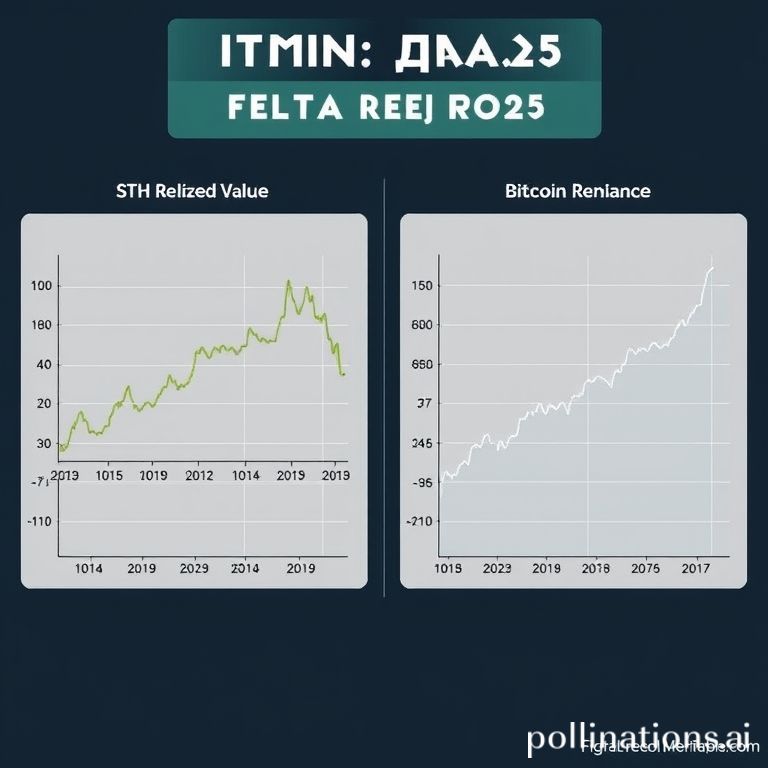
Recent on-chain data has brought to light a significant development within the Bitcoin ecosystem: the Short-Term Holder (STH) Realized Value RVT has experienced a notable decline, approaching its cyclical lows. This particular metric, crucial for gauging market sentiment and the immediate positioning of Bitcoin investors, often signals pivotal shifts in the cryptocurrency's price trajectory. Historically, such movements have been associated with periods of market recalibration, potentially setting the stage for future growth. Understanding the nuances of this indicator, alongside other key metrics like Bitcoin dominance, provides a comprehensive lens through which to analyze BTC's current market health and potential future direction.
Understanding Bitcoin's Short-Term Holder Realized Value RVT
To fully appreciate the implications of the current STH Realized Value RVT trend, it is essential to first grasp what this metric represents and why it holds such significance in cryptocurrency analysis.
What is Realized Value RVT?
The Realized Value RVT is an sophisticated on-chain oscillator designed to provide insight into the financial activities of Bitcoin holders. Specifically, it quantifies the ratio between the aggregated sum of profits and losses realized by investors and the total transfer volume occurring across the Bitcoin network. In essence, this metric serves as a barometer, indicating the extent to which market participants are engaging in profit-taking or loss-taking relative to the sheer volume of value being transacted on the blockchain. A high RVT suggests a period of significant realization of gains or losses, often indicative of heightened volatility or market exhaustion, whereas a low RVT points to reduced realization activity, where coins are moving closer to their acquisition costs.
Significance for Short-Term Holders
While the Realized Value RVT can be applied to various cohorts of holders, its application to Short-Term Holders (STHs) offers particularly acute insights into immediate market dynamics. STHs are defined as those investors who have acquired their Bitcoin within the past 155 days. This cohort is typically considered more reactive to price fluctuations and market news, often exhibiting higher sensitivity to short-term volatility compared to long-term holders. Therefore, analyzing the STH Realized Value RVT specifically allows analysts to gauge the sentiment and behavioral patterns of the most speculative segment of the market. A plummeting STH RVT, as observed recently, suggests that this group is realizing fewer profits or losses compared to the overall volume of transactions, implying that a substantial portion of their holdings might be trading at or near their break-even points. This can be a precursor to accumulation or a sign of market fatigue where investors are less inclined to sell at current prices.
Analyzing Recent Trends and Historical Precedents
The recent trajectory of the Bitcoin STH Realized Value RVT paints a compelling picture of a market undergoing a significant phase of re-evaluation. The indicator's drastic decline has positioned its value remarkably close to historical cyclical lows, a phenomenon that has often preceded substantial market movements.
Current Decline and Its Implications
As documented by on-chain analytics firm Glassnode, the recent descent of the STH Realized Value RVT implies that Bitcoin investors, particularly those who have held their assets for less than 155 days, are currently realizing a considerably lower amount of profit or loss relative to the total transfer volume on the network. This trend signifies a shift towards a market state where a majority of coins are transacting at or very near their acquisition cost, effectively operating at a 'break-even' point for many short-term participants. Such conditions often reduce selling pressure, as the incentive to liquidate holdings for either significant profit or loss diminishes, leading to a period of consolidation.
Historical Context and Market Resets
Glassnode's analysis underscores that these "resets" in the STH Realized Value RVT are not merely statistical anomalies but often correspond with crucial periods of "market detox." These detox phases are vital for cleansing excessive leverage, shaking out weak hands, and establishing a more robust foundation for subsequent, more sustainable market recoveries. Historical data supports this observation: analogous STH Realized Value RVT levels were witnessed during the market lows of mid-2024 and early-2025, which ultimately paved the way for bullish trends. In 2023, the indicator had to fall even lower before Bitcoin managed to regain a strong footing, illustrating that while a low RVT is a strong signal, the exact bottom can vary. The pressing question now for market observers is whether the present low levels of STH Realized Value RVT indicate that Bitcoin has already found its bottom, or if further capitulation is required before a definitive uptrend can commence. Nevertheless, the pattern suggests that the market is undergoing a necessary phase of consolidation, which is fundamentally healthy for long-term growth.
The Role of Bitcoin Dominance in Market Health
Beyond the specific dynamics of short-term holders, the broader market structure, particularly Bitcoin dominance, offers additional clues about the overall health and maturity of the cryptocurrency market.
Understanding Bitcoin Dominance
Bitcoin dominance refers to Bitcoin's market capitalization as a percentage of the total cryptocurrency market capitalization. It is a key metric that indicates the relative strength and investor preference for Bitcoin compared to alternative cryptocurrencies (altcoins). A rising Bitcoin dominance often suggests a flight to safety or a period where Bitcoin is outperforming altcoins, while a declining dominance typically points to an "altcoin season" where altcoins see significant gains.
Recent Rebound and Healthier Market Structure
In a parallel healthy development, Glassnode also highlighted a recent reversal in Bitcoin dominance. After dipping to approximately 57%, the metric has seen a noticeable rebound, climbing back to 59%. This mean reversion, as articulated by the analytics firm, is indicative of a "healthier market structure." The historical precedent suggests that rallies led by Bitcoin itself tend to be more enduring and sustainable than those primarily fueled by altcoins. When Bitcoin leads the charge, it often signifies stronger fundamental market conviction and broader institutional interest, providing a more stable bedrock for the entire crypto market. Conversely, altcoin-driven rallies, while often spectacular in their short-term gains, can sometimes be more speculative and less sustainable without Bitcoin's robust performance as an anchor. The current rebound in dominance, therefore, reinforces the narrative of a market seeking stability and building a foundation from its primary asset.
Conclusion: Implications for Bitcoin's Future Trajectory
The confluence of a rapidly declining Short-Term Holder Realized Value RVT nearing cycle lows and a noticeable rebound in Bitcoin dominance presents a compelling narrative for the current state of the Bitcoin market. The STH RVT suggests that the market is undergoing a crucial "detox" phase, where short-term speculative pressures are being alleviated, leading to a more stable distribution of holdings around break-even prices. This historical pattern of reset often precedes robust recoveries, building a resilient foundation for future price appreciation.
Simultaneously, the restoration of Bitcoin's market dominance indicates a return to a more traditional and historically sustainable market structure, where Bitcoin-led growth provides stability for the broader cryptocurrency landscape. These combined indicators paint a cautiously optimistic picture, suggesting that while the immediate future might still hold volatility, the underlying conditions are conducive to a healthy market evolution. As of writing, Bitcoin is trading around $117,000, having shown a 3% increase over the last week, reflecting a tentative but positive market response to these developing on-chain dynamics. Investors will undoubtedly be closely monitoring these metrics to confirm whether the market has indeed completed its necessary reset and is now poised for a more sustained uptrend.


