
Global AI Shift: US Capex vs. China's Breakthroughs
%20to%20East%20(China)%20regarding%20AI%20innovation%20and%20investment.%20Represent%20elements%20of%20advanced%20AI%20technology%20like%20neural%20networks%2C%20data%20streams%2C%20and%20glowing%20nodes%2C%20with%20a%20subtle%20'fading'%20effect%20on%20the%20Western%20side%20and%20'brightening'%20on%20the%20Eastern%20side%2C%20symbolizing%20the%20changing%20landscape%20of%20global%20AI%20leadership.?width=768&height=768&seed=610755&nologo=true)
The recent market downturn, characterized by a significant tech rout on the Nasdaq and a spike in the VIX, has sent ripples through global markets, including the ASX. While a tentative recovery has emerged, signaling short-term 'buy the dip' sentiment, a more profound question lingers: Is the established 'North Star' of US tech, which has long guided investment portfolios, beginning to wane?
Key Points:
- Recent tech market volatility highlights investor anxiety over soaring AI capital expenditure.
- US tech giants are investing heavily in AI infrastructure with disproportionate revenue returns.
- China's Kimi Linear offers a breakthrough in AI memory (context window), making AI more efficient and cost-effective.
- Western innovation continues with Edison AI's Kosmos, demonstrating practical AI applications in science.
- The global AI landscape is evolving, with a potential shift in the innovation narrative from West to East, fragmenting investment opportunities.
US Tech's Soaring Spending Machine and Investor Anxiety
Amidst this volatility, a paradox within the US tech sector becomes increasingly apparent. While tech earnings continue their ascent, signaling underlying growth, the sheer scale of capital expenditure (capex) in AI infrastructure has reached unprecedented levels. This massive outlay, particularly by industry titans like Microsoft, Google, and Meta, who are collectively projected to funnel US$200 billion into AI infrastructure this year, contrasts sharply with their actual AI revenue, which currently stands at only a quarter of that figure. This disparity fuels growing investor anxiety, exemplified by Meta's recent spending plans that sent investors retreating, despite its efforts to acquire top talent without a clear product launch. Similarly, AMD reported soaring sales, yet its shares barely budged, illustrating a widening chasm between market expectations and tangible returns on investment. We are, in essence, funding what could be the most expensive science experiment in history with shareholders' money, and investors are rightly growing anxious as silence persists from these major tech players.
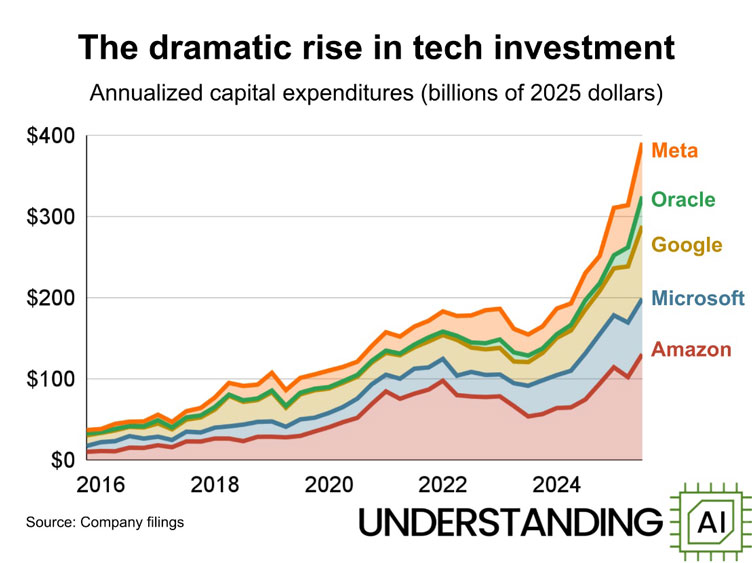
Source: Understanding AI
China's Paradigm Shift: The Kimi Linear Breakthrough
While Western giants grapple with the economics of AI scaling, a significant paradigm shift is originating from Chinese research labs. This innovation addresses a critical bottleneck in current AI systems: the 'goldfish memory' problem. Existing Large Language Models (LLMs), while powerful due to their ability to process relationships between every word, face exponentially increasing costs with longer text lengths—doubling text length can quadruple costs. This limitation results in AI assistants needing constant context refreshers and restricts their capacity for complex, sustained tasks. Previous workarounds have lacked robustness.
Enter Kimi Linear, a groundbreaking development from China, which promises to revolutionize AI memory. By processing information six times faster and more affordably, Kimi Linear can handle an extraordinary 1 million tokens of context, equivalent to approximately 750,000 words. This capability starkly contrasts with current AI models that often struggle with just 100,000 tokens, enabling Kimi to retain entire books, extensive codebases, or years of emails in memory simultaneously. The core of this breakthrough lies in a novel approach analogous to the human brain's 'learning to forget,' where vital information is retained while trivial data is compressed or discarded.
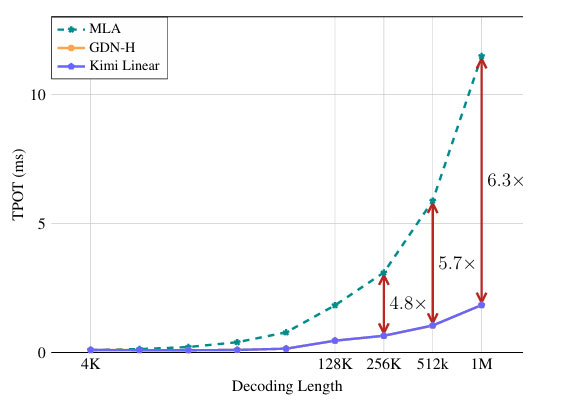
Source: Kimi Linear
Implications for Investment and Global Innovation
The ramifications of such a breakthrough for investment portfolios are substantial. Without robust memory capabilities, AI's potential to truly automate complex jobs and deliver the anticipated productivity revolution remains constrained, making the colossal spending difficult to justify. The emergence of Kimi Linear underscores a compelling truth: significant AI innovation is not exclusively confined to Silicon Valley or London. This development potentially signals a shift in the global innovation narrative, with China increasingly positioned not merely as a manufacturing hub but as a pioneering force in the foundational infrastructure of tomorrow's economy. While Kimi Linear might still be considered a 'band-aid' solution for larger challenges, it is a crucial one that keeps the AI scaling story alive and potentially shifts the innovation spotlight eastward.
Western Resilience: Edison AI's Kosmos Rises Again
Despite this perceived eastward shift, the West continues to demonstrate formidable innovative capacity. Edison AI's recent release of Kosmos, an AI scientist, offers a compelling counter-narrative. Kosmos showcases incredible potential, capable of condensing six months of scientific work into a single day, reading 1,500 research papers, generating 42,000 lines of code, and producing findings with a 79% reproducibility rate. To date, Kosmos has made seven validated discoveries across diverse scientific fields, with three reproducing unpublished findings and four being entirely new contributions to science. As Edison's founders aptly state, 'AI-accelerated science is here.' This illustrates that the 'North Star' isn't dead but rather evolving into a broader constellation of specialized innovation.
Conclusion: Fragmenting Opportunities in the AI Landscape
The ongoing advancements, particularly China's push towards potentially commoditizing AI and Western specialized innovations like Kosmos, suggest a future where the monolithic US tech narrative might fragment. If AI indeed becomes a commodity, the investment landscape will likely diversify, moving away from a single guiding 'North Star' to a multitude of smaller, specialized opportunities. Edison AI's success with Kosmos proves that immense value can still be created without an 'ocean-boiling' approach. While the established North Star has guided us thus far, adapting portfolios to reflect this new, globally distributed landscape of AI innovation will be crucial for navigating the path ahead and capitalizing on the evolving dynamics of the future economy.


