
Tokenized Real-World Assets Soar to $8.3B: Top Crypto Picks
%20are%20connected%20by%20digital%20lines%20to%20this%20blockchain%2C%20symbolizing%20collaboration.%20Elements%20of%20data%2C%20smart%20contracts%2C%20and%20secure%20transactions%20are%20visually%20intertwined.%20The%20overall%20mood%20is%20innovative%2C%20trustworthy%2C%20and%20rapidly%20evolving%2C%20with%20a%20blend%20of%20digital%20and%20traditional%20aesthetics.%20Focus%20on%20showing%20the%20transformation%20of%20real-world%20assets%20into%20digital%20tokens.?width=768&height=768&seed=740131&nologo=true)
The financial landscape is currently undergoing a transformative shift, as traditional finance (TradFi) increasingly converges with decentralized finance (DeFi) through the burgeoning realm of tokenized real-world assets (RWA). Historically, DeFi was envisioned as a direct competitor to TradFi, offering a parallel financial system characterized by transparency, on-chain accountability, and native digital assets. However, this narrative has evolved significantly. Instead of a competitive dynamic, leading financial institutions are actively exploring and integrating blockchain technology, with tokenization emerging as a pivotal area of interest, particularly for assets like US Treasuries.
The Paradigm Shift: From Competition to Collaboration
The initial discourse around DeFi often positioned it as an alternative financial infrastructure designed to circumvent the perceived inefficiencies and opacities of traditional banking systems. This perspective, while foundational to the ethos of decentralization, has been recalibrated by the practical realities of market adoption and regulatory landscapes. Major financial players, recognizing the inherent advantages of blockchain – such as enhanced operational efficiencies, immutable record-keeping, and streamlined asset transfers – have begun to incorporate these innovations into their existing frameworks. This marks a strategic pivot from a "DeFi vs. TradFi" mentality to a "DeFi + TradFi" collaborative model, fostering a new era of digital finance.
Tokenized US Treasuries: A Gateway for Institutional Adoption
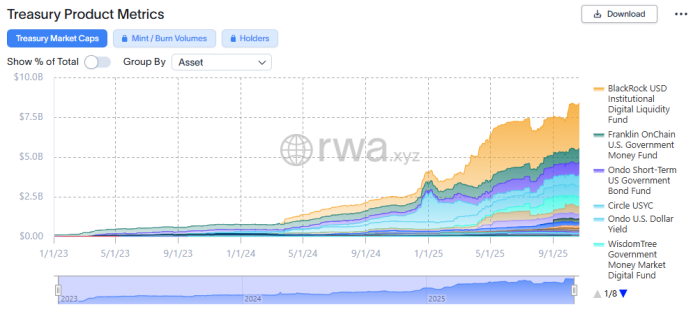
A prime example of this integration is the rapid growth in tokenized US Treasuries. Recent data indicates that over $8.3 billion in Treasuries are already tokenized on-chain, with broader estimates suggesting the total value could be closer to $24-30 billion. This remarkable surge highlights the appeal of tokenization for established financial entities. Institutions like Goldman Sachs and BNY Mellon, which previously maintained a cautious stance on crypto custody due to regulatory and accounting complexities, are now actively tokenizing money-market funds, short-term government debt, and other highly liquid assets. The motivation behind this adoption is primarily operational: tokenized funds enable corporate treasurers to expedite cash movements, enhance asset flexibility for collateralization, and execute trades outside conventional market hours, thereby optimizing liquidity management and operational agility.
The Critical Role of Custody in a Tokenized Future
As the tokenization of real-world assets gains momentum, the demand for robust and secure custody solutions becomes paramount. Custody involves the secure holding of both the underlying traditional assets and their corresponding digital tokens. Currently, crypto-native firms such as Coinbase, which boasts approximately $246 billion in assets under custody, along with established players like Fidelity Investments, lead this segment. These custodians typically charge fees ranging from 0.05% to 0.15% of the asset value. Should tokenized cash and Treasuries continue their upward trajectory, potentially reaching $25-40 billion, the annual revenue generated for crypto custodians could range from $300-600 million.
While crypto-native firms possess specialized blockchain expertise and infrastructure, traditional banks bring invaluable client relationships, established trust, and the necessary regulatory permissions for managing extensive balance sheets. The ability for these banks to seamlessly integrate tokenization into their existing custody services presents a significant opportunity to capture a substantial share of this evolving value chain, bridging the gap between legacy financial systems and the decentralized digital economy.
Accelerated Growth in Tokenized Assets
The expansion of tokenization is proceeding at an extraordinary pace. Insights from 2024 reveal substantial growth across various categories:
- The total market capitalization of tokenized assets increased by an impressive 32%.
- Tokenized Treasuries experienced a remarkable surge of 179%.
- Private credit tokenization grew by 40%.
- Tokenized commodities saw a 5% increase.
These trends are projected to accelerate further into 2025, indicating a sustained and deepening institutional engagement with tokenized assets. This rapid growth underscores the increasing recognition of blockchain’s efficiency and transparency benefits within mainstream finance.
Cryptocurrencies Poised for Growth in the Tokenization Era
Amidst this tokenization boom and the increasing integration of blockchain by financial institutions, several cryptocurrencies are uniquely positioned to capitalize on these trends. Projects that facilitate interoperability, provide essential infrastructure, or offer innovative solutions for digital asset management are expected to see significant appreciation.
1. Bitcoin Hyper ($HYPER): A Layer-2 Solution for Bitcoin Scalability
Bitcoin Hyper ($HYPER) is emerging as a critical Layer-2 scaling solution designed to enhance Bitcoin’s capabilities by combining its robust security with the high-throughput architecture of the Solana Virtual Machine (SVM). Its innovative Canonical Bridge enables wrapped Bitcoin ($BTC) to be efficiently staked and transacted on a high-performance Layer 2, facilitating near-instant payments, seamless DeFi integration, and complex smart contract execution. By leveraging ZK-based validation and cross-chain consensus mechanisms, Bitcoin Hyper aims to overcome Bitcoin’s traditional limitations regarding transaction speed and network congestion, unlocking thousands of transactions per second while maintaining a cryptographic link to the Bitcoin mainnet. Holders of $HYPER can stake tokens to earn yield, participate in governance, and engage with DeFi ecosystems using their $BTC at an unprecedented scale. With over $24 million already raised in its presale, Bitcoin Hyper is anticipated to be a significant project in 2025, with price predictions suggesting substantial growth.
2. Best Wallet Token ($BEST): Empowering Non-Custodial Digital Asset Management
Best Wallet ($BEST) introduces a non-custodial, multi-chain Web3 wallet specifically engineered for the current wave of crypto adoption and the increasing prevalence of tokenized assets. This platform seamlessly integrates essential DeFi functionalities, token swaps, NFT storage, and exclusive access to advanced crypto presales, all within an intuitive mobile interface. This combination offers users both user-friendly simplicity and powerful on-chain capabilities. The $BEST token serves as the backbone of the wallet’s reward ecosystem, providing staking APY, governance rights, and access to launchpad opportunities for early-stage token sales. The project’s strategic roadmap prioritizes interoperability across major networks such as Ethereum, BNB Smart Chain, and Solana, with plans for further expansion. Best Wallet also offers a unique multi-wallet feature, allowing users to create up to five individual wallets within the application, enabling organized token management across different blockchains. As the importance of self-custody and digital asset security grows, $BEST is well-positioned to become a foundational utility token within the broader wallet ecosystem. Its presale has already attracted significant investment, reflecting strong market confidence in its utility and potential for growth.
3. Chainlink ($LINK): Bridging Legacy Finance with Decentralized Oracles
Chainlink ($LINK) is rapidly evolving beyond its role as a premier blockchain oracle network, establishing itself as a vital conduit between conventional financial systems and decentralized environments. Chainlink has actively engaged in strategic collaborations, notably with SWIFT, to enable banks to continue utilizing familiar ISO 20022 message formats while triggering on-chain events via Chainlink’s robust architecture. This innovation allows financial institutions to maintain their established operational processes and infrastructure while effectively integrating tokenized finance. Furthermore, Chainlink introduced the ‘Digital Transfer Agent’ (DTA) technical standard, designed to empower fund administrators and custodians to manage tokenized fund subscriptions and redemptions on-chain, mirroring their existing off-chain processes. A significant initiative involving 24 global financial institutions, including DTCC and Euroclear, aims to standardize corporate-actions data on-chain, thereby streamlining asset-servicing operations. Chainlink's development trajectory is explicitly linked to asset tokenization, with its founder, Sergey Nazarov, frequently highlighting the vast potential market for tokenized assets, extending to hundreds of trillions of dollars. This underscores Chainlink’s ambition to open these markets to the crypto ecosystem.
The Future of Finance: Tokenization as a Cornerstone
The ongoing developments in TradFi and DeFi, particularly concerning tokenization, may appear incremental on the surface, such as the tokenization of money-market funds. However, the underlying implications are profoundly transformative. Financial institutions are strategically positioning themselves to become the custodians and operational pillars of the next generation of digital finance. The movement of tokenized assets, rather than merely their headline valuations, will ultimately dictate which entities control the future balance sheets. Projects like $BEST, $LINK, and $HYPER are poised to play active and instrumental roles in this financial evolution, facilitating the secure, efficient, and transparent management of digital assets.
As always, prospective investors are advised to conduct thorough due diligence and independent research before making any investment decisions. This article does not constitute financial advice.


